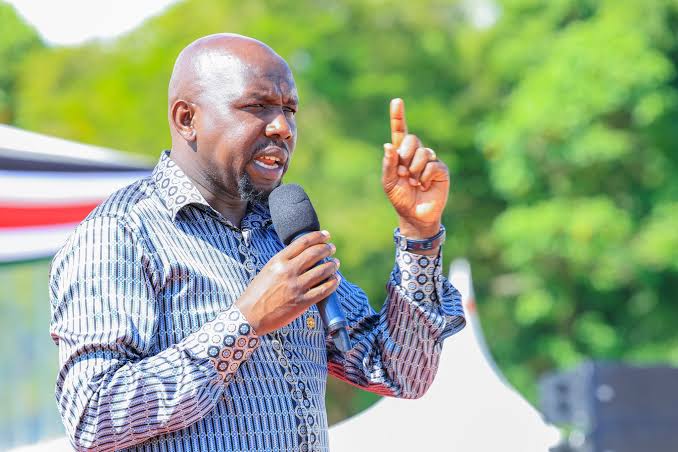
Kenya’s political scene has been thrown into fresh debate following Murkomen’s strong warning to politicians accused of misusing government-provided security while allegedly engaging in activities that could threaten peace and public safety.

I Thought My Stolen Phone Was Gone Forever Until a Stranger Sent Me One Photograph That Exposed a Family Secret Overnight
Speaking during President William Ruto’s tour of the North Rift region, Murkomen maintained that the government would not tolerate leaders who allegedly use public offices and security personnel to facilitate violence.
I Thought My Wife Was Cheating With Our Pastor Until a Phone Exposed the Secret That Nearly Destroyed Our Marriage Again
“Political goonism must be finished. Some politicians are enjoying the security provided by the government. They have police officers but still plan violence,” Murkomen said.

I Thought My Children Had Stopped Speaking to Me Until a Hearing Test Revealed Why I Had Missed Their Words for Years
The Interior CS added that security agencies would remain firm in dealing with individuals suspected of using government resources to organise unrest.
“We will not allow any politician to use government offices and government security to plan violence,” he added.
George Natembeya at the Centre of the Security Controversy
Murkomen’s remarks came after Governor George Natembeya reported that police officers attached to him had been withdrawn for the second time.
According to reports published on Thursday, October 15, 2026, the officers were recalled at around 11 p.m. on Wednesday. Natembeya said he had not received prior communication about the decision and called on Inspector-General of Police Douglas Kanja to explain why the withdrawal had taken place.
The governor questioned whether the decision had followed the constitutional procedures governing changes to security arrangements for public officials.
Natembeya cited Article 47 of the Constitution, which guarantees the right to fair administrative action, and Articles 238 and 244, which address national security and the professionalism of the National Police Service. He maintained that he was not opposed to lawful security reviews but insisted that they must be conducted fairly and professionally.
Reacting to the development, Murkomen accused the governor of associating with individuals he described as goons and planning chaos.
The controversy has widened after Siaya Governor James Orengo also reported that his security detail had also been withdrawn.
On Thursday, October 15, Orengo said the government had withdrawn his security again, describing the incident as part of a series of similar occurrences.
“I remain unbowed,” Orengo said in a social media post.
His reported security withdrawal came shortly after he attended the first anniversary memorial of former Prime Minister Raila Odinga in Bondo. However, the specific reasons for the reported withdrawal of Orengo’s security had not been established in the available reporting.
The developments involving the two governors have raised questions about how security arrangements for senior public officials are reviewed as the country approaches the 2027 General Election.
Murkomen’s Warning to Politicians Ahead of 2027
Murkomen has repeatedly warned political leaders against inciting violence, mobilising gangs or using young people to disrupt political gatherings.
In August 2026, the Interior CS urged politicians to compete through policies and development programmes rather than violence. He also warned that security agencies would act against individuals involved in disrupting political meetings.
The latest controversy places the government’s approach to political violence under renewed scrutiny, particularly as political activity intensifies ahead of the next general election.
For the government, the stated priority is preventing violence and ensuring that public resources are not misused. For affected politicians, the central question is whether decisions affecting their security are supported by clear reasons and follow the law.
The National Police Service’s handling of such cases will therefore be important in determining whether the public has confidence that security decisions are based on professional assessments rather than political disagreements.